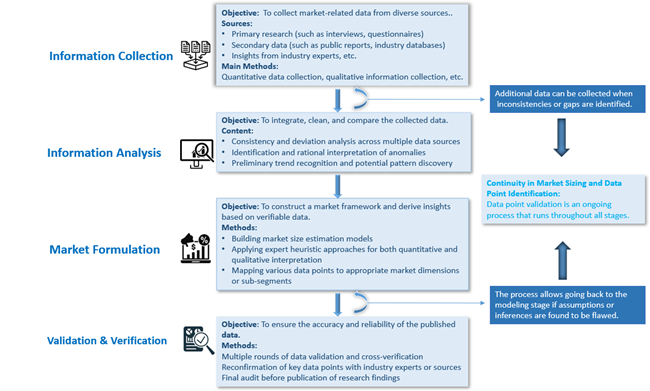
Definition and Scope: AV cables for residential use refer to audio and video cables designed to connect various electronic devices such as TVs, speakers, gaming consoles, and streaming devices within a home entertainment system. These cables transmit audio and video signals from one device to another, ensuring high-quality sound and picture output. AV cables come in different types such as HDMI, RCA, optical, and coaxial cables, each serving a specific purpose in the setup of a home theater system. With the increasing demand for high-definition audio and video content in residential settings, the market for AV cables for residential use has been experiencing steady growth. The market trend for AV cables for residential use is driven by technological advancements in audio and video equipment, leading to the need for higher quality cables to support these devices. As consumers upgrade to 4K and even 8K TVs, there is a growing demand for HDMI cables that can transmit high-resolution video and audio signals without loss of quality. Additionally, the rise of smart home technology and the increasing popularity of streaming services have further fueled the demand for AV cables that can support these advanced functionalities. In addition, the growing trend of home entertainment systems and gaming setups has also contributed to the increasing sales of AV cables for residential use. The global AV Cables for Residential market size was estimated at USD 254.84 million in 2024, exhibiting a CAGR of 4.40% during the forecast period. This report offers a comprehensive analysis of the global AV Cables for Residential market, examining all key dimensions. It provides both a macro-level overview and micro-level market details, including market size, trends, competitive landscape, niche segments, growth drivers, and key challenges. Report Framework and Key Highlights: Market Dynamics: Identification of major market drivers, restraints, opportunities, and challenges. Trend Analysis: Examination of ongoing and emerging trends impacting the market. Competitive Landscape: Detailed profiles and market positioning of major players, including market share, operational status, product offerings, and strategic developments. Strategic Analysis Tools: SWOT Analysis, Porter’s Five Forces Analysis, PEST Analysis, Value Chain Analysis Market Segmentation: By type, application, region, and end-user industry. Forecasting and Growth Projections: In-depth revenue forecasts and CAGR analysis through 2033. This report equips readers with critical insights to navigate competitive dynamics and develop effective strategies. Whether assessing a new market entry or refining existing strategies, the report serves as a valuable tool for: Industry players Investors Researchers Consultants Business strategists And all stakeholders with an interest or investment in the AV Cables for Residential market. Global AV Cables for Residential Market: Segmentation Analysis and Strategic Insights This section of the report provides an in-depth segmentation analysis of the global AV Cables for Residential market. The market is segmented based on region (country), manufacturer, product type, and application. Segmentation enables a more precise understanding of market dynamics and facilitates targeted strategies across product development, marketing, and sales. By breaking the market into meaningful subsets, stakeholders can better tailor their offerings to the specific needs of each segment—enhancing competitiveness and improving return on investment. Global AV Cables for Residential Market: Market Segmentation Analysis The research report includes specific segments by region (country), manufacturers, Type, and Application. Market segmentation creates subsets of a market based on product type, end-user or application, Geographic, and other factors. By understanding the market segments, the decision-maker can leverage this targeting in the product, sales, and marketing strategies. Market segments can power your product development cycles by informing how you create product offerings for different segments. Key Companies Profiled Amphenol Corporation Black Box Corporation Belden Inc. Commscope Foxconn Technology Group LEGRAND SA Nexans WESCO International Prysmian Group Market Segmentation by Type Copper Cable Fiber Optics Coaxial Cables Market Segmentation by Application Audio Video Devices 4K/UHD Televisions Miniature Multimedia Devices Geographic Segmentation North America: United States, Canada, Mexico Europe: Germany, France, Italy, U.K., Spain, Sweden, Denmark, Netherlands, Switzerland, Belgium, Russia. Asia-Pacific: China, Japan, South Korea, India, Australia, Indonesia, Malaysia, Philippines, Singapore, Thailand South America: Brazil, Argentina, Colombia. Middle East and Africa (MEA): Saudi Arabia, United Arab Emirates, Egypt, Nigeria, South Africa, Rest of MEA Report Framework and Chapter Summary Chapter 1: Report Scope and Market Definition This chapter outlines the statistical boundaries and scope of the report. It defines the segmentation standards used throughout the study, including criteria for dividing the market by region, product type, application, and other relevant dimensions. It establishes the foundational definitions and classifications that guide the rest of the analysis. Chapter 2: Executive Summary This chapter presents a concise summary of the market’s current status and future outlook across different segments—by geography, product type, and application. It includes key metrics such as market size, growth trends, and development potential for each segment. The chapter offers a high-level overview of the AV Cables for Residential Market, highlighting its evolution over the short, medium, and long term. Chapter 3: Market Dynamics and Policy Environment This chapter explores the latest developments in the market, identifying key growth drivers, restraints, challenges, and risks faced by industry participants. It also includes an analysis of the policy and regulatory landscape affecting the market, providing insight into how external factors may shape future performance. Chapter 4: Competitive Landscape This chapter provides a detailed assessment of the market's competitive environment. It covers market share, production capacity, output, pricing trends, and strategic developments such as mergers, acquisitions, and expansion plans of leading players. This analysis offers a comprehensive view of the positioning and performance of top competitors. Chapters 5–10: Regional Market Analysis These chapters offer in-depth, quantitative evaluations of market size and growth potential across major regions and countries. Each chapter assesses regional consumption patterns, market dynamics, development prospects, and available capacity. The analysis helps readers understand geographical differences and opportunities in global markets. Chapter 11: Market Segmentation by Product Type This chapter examines the market based on product type, analyzing the size, growth trends, and potential of each segment. It helps stakeholders identify underexplored or high-potential product categories—often referred to as “blue ocean” opportunities. Chapter 12: Market Segmentation by Application This chapter analyzes the market based on application fields, providing insights into the scale and future development of each application segment. It supports readers in identifying high-growth areas across downstream markets. Chapter 13: Company Profiles This chapter presents comprehensive profiles of leading companies operating in the market. For each company, it details sales revenue, volume, pricing, gross profit margin, market share, product offerings, and recent strategic developments. This section offers valuable insight into corporate performance and strategy. Chapter 14: Industry Chain and Value Chain Analysis This chapter explores the full industry chain, from upstream raw material suppliers to downstream application sectors. It includes a value chain analysis that highlights the interconnections and dependencies across various parts of the ecosystem. Chapter 15: Key Findings and Conclusions The final chapter summarizes the main takeaways from the report, presenting the core conclusions, strategic recommendations, and implications for stakeholders. It encapsulates the insights drawn from all previous chapters. Table of Contents 1 Introduction to Research & Analysis Reports 1.1 AV Cables for Residential Market Definition 1.2 AV Cables for Residential Market Segments 1.2.1 Segment by Type 1.2.2 Segment by Application 2 Executive Summary 2.1 Global AV Cables for Residential Market Size 2.2 Market Segmentation – by Type 2.3 Market Segmentation – by Application 2.4 Market Segmentation – by Geography 3 Key Market Trends, Opportunity, Drivers and Restraints 3.1 Key Takeway 3.2 Market Opportunities & Trends 3.3 Market Drivers 3.4 Market Restraints 3.5 Market Major Factor Assessment 4 Global AV Cables for Residential Market Competitive Landscape 4.1 Global AV Cables for Residential Sales by Manufacturers (2020-2025) 4.2 Global AV Cables for Residential Revenue Market Share by Manufacturers (2020-2025) 4.3 AV Cables for Residential Market Share by Company Type (Tier 1, Tier 2, and Tier 3) 4.4 New Entrant and Capacity Expansion Plans 4.5 Mergers & Acquisitions 5 Global AV Cables for Residential Market by Region 5.1 Global AV Cables for Residential Market Size by Region 5.1.1 Global AV Cables for Residential Market Size by Region 5.1.2 Global AV Cables for Residential Market Size Market Share by Region 5.2 Global AV Cables for Residential Sales by Region 5.2.1 Global AV Cables for Residential Sales by Region 5.2.2 Global AV Cables for Residential Sales Market Share by Region 6 North America Market Overview 6.1 North America AV Cables for Residential Market Size by Country 6.1.1 USA Market Overview 6.1.2 Canada Market Overview 6.1.3 Mexico Market Overview 6.2 North America AV Cables for Residential Market Size by Type 6.3 North America AV Cables for Residential Market Size by Application 6.4 Top Players in North America AV Cables for Residential Market 7 Europe Market Overview 7.1 Europe AV Cables for Residential Market Size by Country 7.1.1 Germany Market Overview 7.1.2 France Market Overview 7.1.3 U.K. Market Overview 7.1.4 Italy Market Overview 7.1.5 Spain Market Overview 7.1.6 Sweden Market Overview 7.1.7 Denmark Market Overview 7.1.8 Netherlands Market Overview 7.1.9 Switzerland Market Overview 7.1.10 Belgium Market Overview 7.1.11 Russia Market Overview 7.2 Europe AV Cables for Residential Market Size by Type 7.3 Europe AV Cables for Residential Market Size by Application 7.4 Top Players in Europe AV Cables for Residential Market 8 Asia-Pacific Market Overview 8.1 Asia-Pacific AV Cables for Residential Market Size by Country 8.1.1 China Market Overview 8.1.2 Japan Market Overview 8.1.3 South Korea Market Overview 8.1.4 India Market Overview 8.1.5 Australia Market Overview 8.1.6 Indonesia Market Overview 8.1.7 Malaysia Market Overview 8.1.8 Philippines Market Overview 8.1.9 Singapore Market Overview 8.1.10 Thailand Market Overview 8.1.11 Rest of APAC Market Overview 8.2 Asia-Pacific AV Cables for Residential Market Size by Type 8.3 Asia-Pacific AV Cables for Residential Market Size by Application 8.4 Top Players in Asia-Pacific AV Cables for Residential Market 9 South America Market Overview 9.1 South America AV Cables for Residential Market Size by Country 9.1.1 Brazil Market Overview 9.1.2 Argentina Market Overview 9.1.3 Columbia Market Overview 9.2 South America AV Cables for Residential Market Size by Type 9.3 South America AV Cables for Residential Market Size by Application 9.4 Top Players in South America AV Cables for Residential Market 10 Middle East and Africa Market Overview 10.1 Middle East and Africa AV Cables for Residential Market Size by Country 10.1.1 Saudi Arabia Market Overview 10.1.2 UAE Market Overview 10.1.3 Egypt Market Overview 10.1.4 Nigeria Market Overview 10.1.5 South Africa Market Overview 10.2 Middle East and Africa AV Cables for Residential Market Size by Type 10.3 Middle East and Africa AV Cables for Residential Market Size by Application 10.4 Top Players in Middle East and Africa AV Cables for Residential Market 11 AV Cables for Residential Market Segmentation by Type 11.1 Evaluation Matrix of Segment Market Development Potential (Type) 11.2 Global AV Cables for Residential Sales Market Share by Type (2020-2033) 11.3 Global AV Cables for Residential Market Size Market Share by Type (2020-2033) 11.4 Global AV Cables for Residential Price by Type (2020-2033) 12 AV Cables for Residential Market Segmentation by Application 12.1 Evaluation Matrix of Segment Market Development Potential (Application) 12.2 Global AV Cables for Residential Market Sales by Application (2020-2033) 12.3 Global AV Cables for Residential Market Size (M USD) by Application (2020-2033) 12.4 Global AV Cables for Residential Sales Growth Rate by Application (2020-2033) 13 Company Profiles 13.1 Amphenol Corporation 13.1.1 Amphenol Corporation Company Overview 13.1.2 Amphenol Corporation Business Overview 13.1.3 Amphenol Corporation AV Cables for Residential Major Product Offerings 13.1.4 Amphenol Corporation AV Cables for Residential Sales and Revenue fromAV Cables for Residential (2020-2025) 13.1.5 Key News 13.2 Black Box Corporation 13.2.1 Black Box Corporation Company Overview 13.2.2 Black Box Corporation Business Overview 13.2.3 Black Box Corporation AV Cables for Residential Major Product Offerings 13.2.4 Black Box Corporation AV Cables for Residential Sales and Revenue fromAV Cables for Residential (2020-2025) 13.2.5 Key News 13.3 Belden Inc. 13.3.1 Belden Inc. Company Overview 13.3.2 Belden Inc. Business Overview 13.3.3 Belden Inc. AV Cables for Residential Major Product Offerings 13.3.4 Belden Inc. AV Cables for Residential Sales and Revenue fromAV Cables for Residential (2020-2025) 13.3.5 Key News 13.4 Commscope 13.4.1 Commscope Company Overview 13.4.2 Commscope Business Overview 13.4.3 Commscope AV Cables for Residential Major Product Offerings 13.4.4 Commscope AV Cables for Residential Sales and Revenue fromAV Cables for Residential (2020-2025) 13.4.5 Key News 13.5 Foxconn Technology Group 13.5.1 Foxconn Technology Group Company Overview 13.5.2 Foxconn Technology Group Business Overview 13.5.3 Foxconn Technology Group AV Cables for Residential Major Product Offerings 13.5.4 Foxconn Technology Group AV Cables for Residential Sales and Revenue fromAV Cables for Residential (2020-2025) 13.5.5 Key News 13.6 LEGRAND SA 13.6.1 LEGRAND SA Company Overview 13.6.2 LEGRAND SA Business Overview 13.6.3 LEGRAND SA AV Cables for Residential Major Product Offerings 13.6.4 LEGRAND SA AV Cables for Residential Sales and Revenue fromAV Cables for Residential (2020-2025) 13.6.5 Key News 13.7 Nexans 13.7.1 Nexans Company Overview 13.7.2 Nexans Business Overview 13.7.3 Nexans AV Cables for Residential Major Product Offerings 13.7.4 Nexans AV Cables for Residential Sales and Revenue fromAV Cables for Residential (2020-2025) 13.7.5 Key News 13.8 WESCO International 13.8.1 WESCO International Company Overview 13.8.2 WESCO International Business Overview 13.8.3 WESCO International AV Cables for Residential Major Product Offerings 13.8.4 WESCO International AV Cables for Residential Sales and Revenue fromAV Cables for Residential (2020-2025) 13.8.5 Key News 13.9 Prysmian Group 13.9.1 Prysmian Group Company Overview 13.9.2 Prysmian Group Business Overview 13.9.3 Prysmian Group AV Cables for Residential Major Product Offerings 13.9.4 Prysmian Group AV Cables for Residential Sales and Revenue fromAV Cables for Residential (2020-2025) 13.9.5 Key News 14 Key Market Trends, Opportunity, Drivers and Restraints 14.1 Key Takeway 14.2 Market Opportunities & Trends 14.3 Market Drivers 14.4 Market Restraints 14.5 Market Major Factor Assessment 14.6 Porter's Five Forces Analysis of AV Cables for Residential Market 14.7 PEST Analysis of AV Cables for Residential Market 15 Analysis of the AV Cables for Residential Industry Chain 15.1 Overview of the Industry Chain 15.2 Upstream Segment Analysis 15.3 Midstream Segment Analysis 15.3.1 Manufacturing, Processing or Conversion Process Analysis 15.3.2 Key Technology Analysis 15.4 Downstream Segment Analysis 15.4.1 Downstream Customer List and Contact Details 15.4.2 Customer Concerns or Preference Analysis 16 Conclusion 17 Appendix 17.1 Methodology 17.2 Research Process and Data Source 17.3 Disclaimer 17.4 Note 17.5 Examples of Clients 17.6 DisclaimerResearch Methodology The research methodology employed in this study follows a structured, four-stage process designed to ensure the accuracy, consistency, and relevance of all data and insights presented. The process begins with Information Procurement, wherein data is collected from a wide range of primary and secondary sources. This is followed by Information Analysis, during which the collected data is systematically mapped, discrepancies across sources are examined, and consistency is established through cross-validation.
Subsequently, the Market Formulation phase involves placing verified data points into an appropriate market context to generate meaningful conclusions. This step integrates analyst interpretation and expert heuristics to refine findings and ensure applicability. Finally, all conclusions undergo a rigorous Validation and Publishing process, where each data point is re-evaluated before inclusion in the final deliverable. The methodology emphasizes bidirectional flow and reversibility between key stages to maintain flexibility and reinforce the integrity of the analysis.
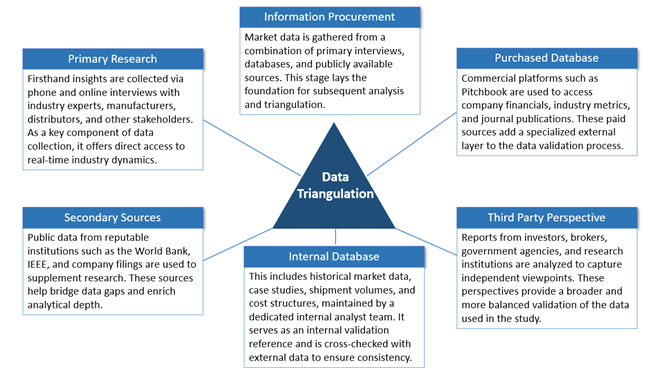
Research Process The market research process follows a structured and iterative methodology designed to ensure accuracy, depth, and reliability. It begins with scope definition and research design, where the research objectives are clearly outlined based on client requirements, emerging market trends, and initial exploratory insights. This phase provides strategic direction for all subsequent stages of the research. Data collection is then conducted through both secondary and primary research. Secondary research involves analyzing publicly available and paid sources such as company filings, industry journals, and government databases to build foundational knowledge. This is followed by primary research, which includes direct interviews and surveys with key industry stakeholders—such as manufacturers, distributors, and end users—to gather firsthand insights and address data gaps identified earlier. Techniques included CATI (Computer-Assisted Telephonic Interviewing), CAWI (Computer-Assisted Web Interviewing), CAVI (Computer-Assisted Video Interviewing via platforms like Zoom and WebEx), and CASI (Computer-Assisted Self Interviewing via email or LinkedIn).