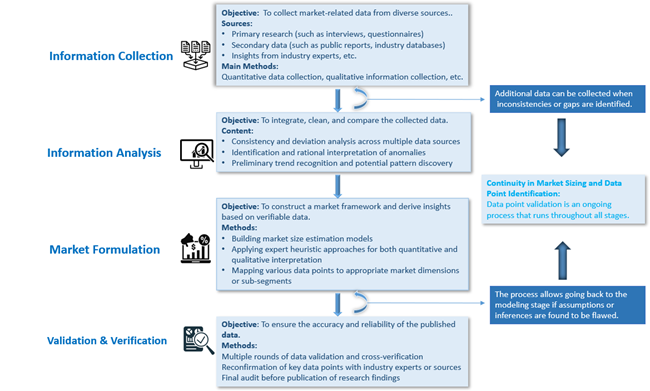
Definition and Scope: The self-propelled transplanter is a specialized agricultural machine designed to automate the process of planting seedlings in fields. It consists of a planting unit that can be adjusted to accommodate different types of crops and row spacing, a seedling tray holder, and a propulsion system that allows for easy maneuverability across various terrains. This machine is crucial for increasing efficiency and reducing labor costs in large-scale farming operations. By automating the planting process, farmers can save time and resources while ensuring consistent plant spacing and depth, leading to higher crop yields. The market for self-propelled transplanters is experiencing steady growth due to several key market trends and drivers. Firstly, there is a growing demand for agricultural machinery that can improve productivity and reduce manual labor dependency. As labor costs continue to rise and the availability of skilled farm workers declines, farmers are increasingly turning to mechanized solutions like self-propelled transplanters to streamline their operations. Additionally, advancements in technology have led to the development of more sophisticated transplanting machines with features such as GPS guidance systems, automatic depth control, and real-time monitoring capabilities, further driving market growth. Moreover, the increasing adoption of precision agriculture practices is also fueling the demand for self-propelled transplanters. By using data-driven insights and technology to optimize planting processes, farmers can achieve higher efficiency, reduce input costs, and minimize environmental impact. This trend towards precision agriculture aligns well with the capabilities of self-propelled transplanters, making them an attractive investment for modern farming operations. In addition, government initiatives promoting sustainable farming practices and the modernization of agriculture are expected to further boost the market for self-propelled transplanters in the coming years. The global Self-propelled Transplanter market size was estimated at USD 503.29 million in 2024, exhibiting a CAGR of 4.20% during the forecast period. This report offers a comprehensive analysis of the global Self-propelled Transplanter market, examining all key dimensions. It provides both a macro-level overview and micro-level market details, including market size, trends, competitive landscape, niche segments, growth drivers, and key challenges. Report Framework and Key Highlights: Market Dynamics: Identification of major market drivers, restraints, opportunities, and challenges. Trend Analysis: Examination of ongoing and emerging trends impacting the market. Competitive Landscape: Detailed profiles and market positioning of major players, including market share, operational status, product offerings, and strategic developments. Strategic Analysis Tools: SWOT Analysis, Porter’s Five Forces Analysis, PEST Analysis, Value Chain Analysis Market Segmentation: By type, application, region, and end-user industry. Forecasting and Growth Projections: In-depth revenue forecasts and CAGR analysis through 2033. This report equips readers with critical insights to navigate competitive dynamics and develop effective strategies. Whether assessing a new market entry or refining existing strategies, the report serves as a valuable tool for: Industry players Investors Researchers Consultants Business strategists And all stakeholders with an interest or investment in the Self-propelled Transplanter market. Global Self-propelled Transplanter Market: Segmentation Analysis and Strategic Insights This section of the report provides an in-depth segmentation analysis of the global Self-propelled Transplanter market. The market is segmented based on region (country), manufacturer, product type, and application. Segmentation enables a more precise understanding of market dynamics and facilitates targeted strategies across product development, marketing, and sales. By breaking the market into meaningful subsets, stakeholders can better tailor their offerings to the specific needs of each segment—enhancing competitiveness and improving return on investment. Global Self-propelled Transplanter Market: Market Segmentation Analysis The research report includes specific segments by region (country), manufacturers, Type, and Application. Market segmentation creates subsets of a market based on product type, end-user or application, Geographic, and other factors. By understanding the market segments, the decision-maker can leverage this targeting in the product, sales, and marketing strategies. Market segments can power your product development cycles by informing how you create product offerings for different segments. Key Companies Profiled FALC Greaves Cotton Limited Honda Power Equipment Kerala Agro Machinery Kirloskar Oil Engines Kranti Agro KUBOTA Corporation Mahindra & Mahindra Minos Agricultural Machinery REKHA AGRIPLAS LIMITED Shrachi Agro V.S.T Weeders Tractors Vijayalaxmi Agro Tools YANMAR Market Segmentation by Type Gasoline Agriculture Transplanter Diesel Agriculture Transplanter Market Segmentation by Application Fruit Vegetable Cereals Geographic Segmentation North America: United States, Canada, Mexico Europe: Germany, France, Italy, U.K., Spain, Sweden, Denmark, Netherlands, Switzerland, Belgium, Russia. Asia-Pacific: China, Japan, South Korea, India, Australia, Indonesia, Malaysia, Philippines, Singapore, Thailand South America: Brazil, Argentina, Colombia. Middle East and Africa (MEA): Saudi Arabia, United Arab Emirates, Egypt, Nigeria, South Africa, Rest of MEA Report Framework and Chapter Summary Chapter 1: Report Scope and Market Definition This chapter outlines the statistical boundaries and scope of the report. It defines the segmentation standards used throughout the study, including criteria for dividing the market by region, product type, application, and other relevant dimensions. It establishes the foundational definitions and classifications that guide the rest of the analysis. Chapter 2: Executive Summary This chapter presents a concise summary of the market’s current status and future outlook across different segments—by geography, product type, and application. It includes key metrics such as market size, growth trends, and development potential for each segment. The chapter offers a high-level overview of the Self-propelled Transplanter Market, highlighting its evolution over the short, medium, and long term. Chapter 3: Market Dynamics and Policy Environment This chapter explores the latest developments in the market, identifying key growth drivers, restraints, challenges, and risks faced by industry participants. It also includes an analysis of the policy and regulatory landscape affecting the market, providing insight into how external factors may shape future performance. Chapter 4: Competitive Landscape This chapter provides a detailed assessment of the market's competitive environment. It covers market share, production capacity, output, pricing trends, and strategic developments such as mergers, acquisitions, and expansion plans of leading players. This analysis offers a comprehensive view of the positioning and performance of top competitors. Chapters 5–10: Regional Market Analysis These chapters offer in-depth, quantitative evaluations of market size and growth potential across major regions and countries. Each chapter assesses regional consumption patterns, market dynamics, development prospects, and available capacity. The analysis helps readers understand geographical differences and opportunities in global markets. Chapter 11: Market Segmentation by Product Type This chapter examines the market based on product type, analyzing the size, growth trends, and potential of each segment. It helps stakeholders identify underexplored or high-potential product categories—often referred to as “blue ocean” opportunities. Chapter 12: Market Segmentation by Application This chapter analyzes the market based on application fields, providing insights into the scale and future development of each application segment. It supports readers in identifying high-growth areas across downstream markets. Chapter 13: Company Profiles This chapter presents comprehensive profiles of leading companies operating in the market. For each company, it details sales revenue, volume, pricing, gross profit margin, market share, product offerings, and recent strategic developments. This section offers valuable insight into corporate performance and strategy. Chapter 14: Industry Chain and Value Chain Analysis This chapter explores the full industry chain, from upstream raw material suppliers to downstream application sectors. It includes a value chain analysis that highlights the interconnections and dependencies across various parts of the ecosystem. Chapter 15: Key Findings and Conclusions The final chapter summarizes the main takeaways from the report, presenting the core conclusions, strategic recommendations, and implications for stakeholders. It encapsulates the insights drawn from all previous chapters. Table of Contents 1 Introduction to Research & Analysis Reports 1.1 Self-propelled Transplanter Market Definition 1.2 Self-propelled Transplanter Market Segments 1.2.1 Segment by Type 1.2.2 Segment by Application 2 Executive Summary 2.1 Global Self-propelled Transplanter Market Size 2.2 Market Segmentation – by Type 2.3 Market Segmentation – by Application 2.4 Market Segmentation – by Geography 3 Key Market Trends, Opportunity, Drivers and Restraints 3.1 Key Takeway 3.2 Market Opportunities & Trends 3.3 Market Drivers 3.4 Market Restraints 3.5 Market Major Factor Assessment 4 Global Self-propelled Transplanter Market Competitive Landscape 4.1 Global Self-propelled Transplanter Sales by Manufacturers (2020-2025) 4.2 Global Self-propelled Transplanter Revenue Market Share by Manufacturers (2020-2025) 4.3 Self-propelled Transplanter Market Share by Company Type (Tier 1, Tier 2, and Tier 3) 4.4 New Entrant and Capacity Expansion Plans 4.5 Mergers & Acquisitions 5 Global Self-propelled Transplanter Market by Region 5.1 Global Self-propelled Transplanter Market Size by Region 5.1.1 Global Self-propelled Transplanter Market Size by Region 5.1.2 Global Self-propelled Transplanter Market Size Market Share by Region 5.2 Global Self-propelled Transplanter Sales by Region 5.2.1 Global Self-propelled Transplanter Sales by Region 5.2.2 Global Self-propelled Transplanter Sales Market Share by Region 6 North America Market Overview 6.1 North America Self-propelled Transplanter Market Size by Country 6.1.1 USA Market Overview 6.1.2 Canada Market Overview 6.1.3 Mexico Market Overview 6.2 North America Self-propelled Transplanter Market Size by Type 6.3 North America Self-propelled Transplanter Market Size by Application 6.4 Top Players in North America Self-propelled Transplanter Market 7 Europe Market Overview 7.1 Europe Self-propelled Transplanter Market Size by Country 7.1.1 Germany Market Overview 7.1.2 France Market Overview 7.1.3 U.K. Market Overview 7.1.4 Italy Market Overview 7.1.5 Spain Market Overview 7.1.6 Sweden Market Overview 7.1.7 Denmark Market Overview 7.1.8 Netherlands Market Overview 7.1.9 Switzerland Market Overview 7.1.10 Belgium Market Overview 7.1.11 Russia Market Overview 7.2 Europe Self-propelled Transplanter Market Size by Type 7.3 Europe Self-propelled Transplanter Market Size by Application 7.4 Top Players in Europe Self-propelled Transplanter Market 8 Asia-Pacific Market Overview 8.1 Asia-Pacific Self-propelled Transplanter Market Size by Country 8.1.1 China Market Overview 8.1.2 Japan Market Overview 8.1.3 South Korea Market Overview 8.1.4 India Market Overview 8.1.5 Australia Market Overview 8.1.6 Indonesia Market Overview 8.1.7 Malaysia Market Overview 8.1.8 Philippines Market Overview 8.1.9 Singapore Market Overview 8.1.10 Thailand Market Overview 8.1.11 Rest of APAC Market Overview 8.2 Asia-Pacific Self-propelled Transplanter Market Size by Type 8.3 Asia-Pacific Self-propelled Transplanter Market Size by Application 8.4 Top Players in Asia-Pacific Self-propelled Transplanter Market 9 South America Market Overview 9.1 South America Self-propelled Transplanter Market Size by Country 9.1.1 Brazil Market Overview 9.1.2 Argentina Market Overview 9.1.3 Columbia Market Overview 9.2 South America Self-propelled Transplanter Market Size by Type 9.3 South America Self-propelled Transplanter Market Size by Application 9.4 Top Players in South America Self-propelled Transplanter Market 10 Middle East and Africa Market Overview 10.1 Middle East and Africa Self-propelled Transplanter Market Size by Country 10.1.1 Saudi Arabia Market Overview 10.1.2 UAE Market Overview 10.1.3 Egypt Market Overview 10.1.4 Nigeria Market Overview 10.1.5 South Africa Market Overview 10.2 Middle East and Africa Self-propelled Transplanter Market Size by Type 10.3 Middle East and Africa Self-propelled Transplanter Market Size by Application 10.4 Top Players in Middle East and Africa Self-propelled Transplanter Market 11 Self-propelled Transplanter Market Segmentation by Type 11.1 Evaluation Matrix of Segment Market Development Potential (Type) 11.2 Global Self-propelled Transplanter Sales Market Share by Type (2020-2033) 11.3 Global Self-propelled Transplanter Market Size Market Share by Type (2020-2033) 11.4 Global Self-propelled Transplanter Price by Type (2020-2033) 12 Self-propelled Transplanter Market Segmentation by Application 12.1 Evaluation Matrix of Segment Market Development Potential (Application) 12.2 Global Self-propelled Transplanter Market Sales by Application (2020-2033) 12.3 Global Self-propelled Transplanter Market Size (M USD) by Application (2020-2033) 12.4 Global Self-propelled Transplanter Sales Growth Rate by Application (2020-2033) 13 Company Profiles 13.1 FALC 13.1.1 FALC Company Overview 13.1.2 FALC Business Overview 13.1.3 FALC Self-propelled Transplanter Major Product Offerings 13.1.4 FALC Self-propelled Transplanter Sales and Revenue fromSelf-propelled Transplanter (2020-2025) 13.1.5 Key News 13.2 Greaves Cotton Limited 13.2.1 Greaves Cotton Limited Company Overview 13.2.2 Greaves Cotton Limited Business Overview 13.2.3 Greaves Cotton Limited Self-propelled Transplanter Major Product Offerings 13.2.4 Greaves Cotton Limited Self-propelled Transplanter Sales and Revenue fromSelf-propelled Transplanter (2020-2025) 13.2.5 Key News 13.3 Honda Power Equipment 13.3.1 Honda Power Equipment Company Overview 13.3.2 Honda Power Equipment Business Overview 13.3.3 Honda Power Equipment Self-propelled Transplanter Major Product Offerings 13.3.4 Honda Power Equipment Self-propelled Transplanter Sales and Revenue fromSelf-propelled Transplanter (2020-2025) 13.3.5 Key News 13.4 Kerala Agro Machinery 13.4.1 Kerala Agro Machinery Company Overview 13.4.2 Kerala Agro Machinery Business Overview 13.4.3 Kerala Agro Machinery Self-propelled Transplanter Major Product Offerings 13.4.4 Kerala Agro Machinery Self-propelled Transplanter Sales and Revenue fromSelf-propelled Transplanter (2020-2025) 13.4.5 Key News 13.5 Kirloskar Oil Engines 13.5.1 Kirloskar Oil Engines Company Overview 13.5.2 Kirloskar Oil Engines Business Overview 13.5.3 Kirloskar Oil Engines Self-propelled Transplanter Major Product Offerings 13.5.4 Kirloskar Oil Engines Self-propelled Transplanter Sales and Revenue fromSelf-propelled Transplanter (2020-2025) 13.5.5 Key News 13.6 Kranti Agro 13.6.1 Kranti Agro Company Overview 13.6.2 Kranti Agro Business Overview 13.6.3 Kranti Agro Self-propelled Transplanter Major Product Offerings 13.6.4 Kranti Agro Self-propelled Transplanter Sales and Revenue fromSelf-propelled Transplanter (2020-2025) 13.6.5 Key News 13.7 KUBOTA Corporation 13.7.1 KUBOTA Corporation Company Overview 13.7.2 KUBOTA Corporation Business Overview 13.7.3 KUBOTA Corporation Self-propelled Transplanter Major Product Offerings 13.7.4 KUBOTA Corporation Self-propelled Transplanter Sales and Revenue fromSelf-propelled Transplanter (2020-2025) 13.7.5 Key News 13.8 Mahindra and Mahindra 13.8.1 Mahindra and Mahindra Company Overview 13.8.2 Mahindra and Mahindra Business Overview 13.8.3 Mahindra and Mahindra Self-propelled Transplanter Major Product Offerings 13.8.4 Mahindra and Mahindra Self-propelled Transplanter Sales and Revenue fromSelf-propelled Transplanter (2020-2025) 13.8.5 Key News 13.9 Minos Agricultural Machinery 13.9.1 Minos Agricultural Machinery Company Overview 13.9.2 Minos Agricultural Machinery Business Overview 13.9.3 Minos Agricultural Machinery Self-propelled Transplanter Major Product Offerings 13.9.4 Minos Agricultural Machinery Self-propelled Transplanter Sales and Revenue fromSelf-propelled Transplanter (2020-2025) 13.9.5 Key News 13.10 REKHA AGRIPLAS LIMITED 13.10.1 REKHA AGRIPLAS LIMITED Company Overview 13.10.2 REKHA AGRIPLAS LIMITED Business Overview 13.10.3 REKHA AGRIPLAS LIMITED Self-propelled Transplanter Major Product Offerings 13.10.4 REKHA AGRIPLAS LIMITED Self-propelled Transplanter Sales and Revenue fromSelf-propelled Transplanter (2020-2025) 13.10.5 Key News 13.11 Shrachi Agro 13.11.1 Shrachi Agro Company Overview 13.11.2 Shrachi Agro Business Overview 13.11.3 Shrachi Agro Self-propelled Transplanter Major Product Offerings 13.11.4 Shrachi Agro Self-propelled Transplanter Sales and Revenue fromSelf-propelled Transplanter (2020-2025) 13.11.5 Key News 13.12 V.S.T Weeders Tractors 13.12.1 V.S.T Weeders Tractors Company Overview 13.12.2 V.S.T Weeders Tractors Business Overview 13.12.3 V.S.T Weeders Tractors Self-propelled Transplanter Major Product Offerings 13.12.4 V.S.T Weeders Tractors Self-propelled Transplanter Sales and Revenue fromSelf-propelled Transplanter (2020-2025) 13.12.5 Key News 13.13 Vijayalaxmi Agro Tools 13.13.1 Vijayalaxmi Agro Tools Company Overview 13.13.2 Vijayalaxmi Agro Tools Business Overview 13.13.3 Vijayalaxmi Agro Tools Self-propelled Transplanter Major Product Offerings 13.13.4 Vijayalaxmi Agro Tools Self-propelled Transplanter Sales and Revenue fromSelf-propelled Transplanter (2020-2025) 13.13.5 Key News 13.14 YANMAR 13.14.1 YANMAR Company Overview 13.14.2 YANMAR Business Overview 13.14.3 YANMAR Self-propelled Transplanter Major Product Offerings 13.14.4 YANMAR Self-propelled Transplanter Sales and Revenue fromSelf-propelled Transplanter (2020-2025) 13.14.5 Key News 14 Key Market Trends, Opportunity, Drivers and Restraints 14.1 Key Takeway 14.2 Market Opportunities & Trends 14.3 Market Drivers 14.4 Market Restraints 14.5 Market Major Factor Assessment 14.6 Porter's Five Forces Analysis of Self-propelled Transplanter Market 14.7 PEST Analysis of Self-propelled Transplanter Market 15 Analysis of the Self-propelled Transplanter Industry Chain 15.1 Overview of the Industry Chain 15.2 Upstream Segment Analysis 15.3 Midstream Segment Analysis 15.3.1 Manufacturing, Processing or Conversion Process Analysis 15.3.2 Key Technology Analysis 15.4 Downstream Segment Analysis 15.4.1 Downstream Customer List and Contact Details 15.4.2 Customer Concerns or Preference Analysis 16 Conclusion 17 Appendix 17.1 Methodology 17.2 Research Process and Data Source 17.3 Disclaimer 17.4 Note 17.5 Examples of Clients 17.6 DisclaimerResearch Methodology The research methodology employed in this study follows a structured, four-stage process designed to ensure the accuracy, consistency, and relevance of all data and insights presented. The process begins with Information Procurement, wherein data is collected from a wide range of primary and secondary sources. This is followed by Information Analysis, during which the collected data is systematically mapped, discrepancies across sources are examined, and consistency is established through cross-validation.
Subsequently, the Market Formulation phase involves placing verified data points into an appropriate market context to generate meaningful conclusions. This step integrates analyst interpretation and expert heuristics to refine findings and ensure applicability. Finally, all conclusions undergo a rigorous Validation and Publishing process, where each data point is re-evaluated before inclusion in the final deliverable. The methodology emphasizes bidirectional flow and reversibility between key stages to maintain flexibility and reinforce the integrity of the analysis.
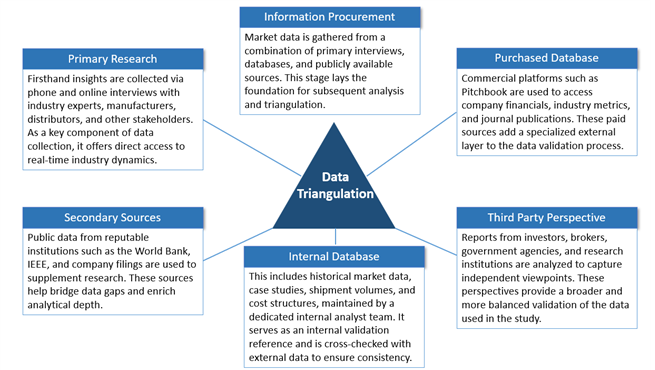
Research Process The market research process follows a structured and iterative methodology designed to ensure accuracy, depth, and reliability. It begins with scope definition and research design, where the research objectives are clearly outlined based on client requirements, emerging market trends, and initial exploratory insights. This phase provides strategic direction for all subsequent stages of the research. Data collection is then conducted through both secondary and primary research. Secondary research involves analyzing publicly available and paid sources such as company filings, industry journals, and government databases to build foundational knowledge. This is followed by primary research, which includes direct interviews and surveys with key industry stakeholders—such as manufacturers, distributors, and end users—to gather firsthand insights and address data gaps identified earlier. Techniques included CATI (Computer-Assisted Telephonic Interviewing), CAWI (Computer-Assisted Web Interviewing), CAVI (Computer-Assisted Video Interviewing via platforms like Zoom and WebEx), and CASI (Computer-Assisted Self Interviewing via email or LinkedIn).